

Brace vs Stock? Here's What Separates Them on Your Pistol
Posted by Jeremy Mallette on Oct 9th 2026
Set a pistol brace and a stock on the same workbench, and many shooters would struggle to tell them apart at a glance. They mount in the same general spot, run about the same size, and sometimes share the same attachment point. Federal law ignores the resemblance and asks a narrower question: where the firearm is built to meet your body.
That one answer decides whether your pistol stays a pistol.
The short answer. A pistol brace attaches to your forearm to steady a handgun you still fire as a handgun. A stock is built to press into your shoulder, and a shoulder-fired gun is a rifle under federal law. Pair a stock with a barrel under 16 inches, and you have a short-barreled rifle (SBR), regulated under the National Firearms Act (NFA). As of September 23, 2026, a braced pistol is classified as a pistol at the federal level.
What Is a Pistol Brace?
A pistol brace is a rear-mounted accessory with a strap, cuff, or narrow fin that wraps around or rests against the forearm of your shooting arm. The first commercial designs appeared around 2012, built so shooters with limited grip strength or mobility (disabled veterans in particular) could hold a heavy AR-style pistol steady with one arm.
The mechanics are simple. Your hands give a handgun two points of contact. A brace adds a third point of contact along your forearm, and that extra anchor cuts muzzle rise, reduces wobble between shots, and delays the fatigue that creeps in around your fiftieth round. Our What Are Pistol Braces guide covers the history and mechanics in more depth.
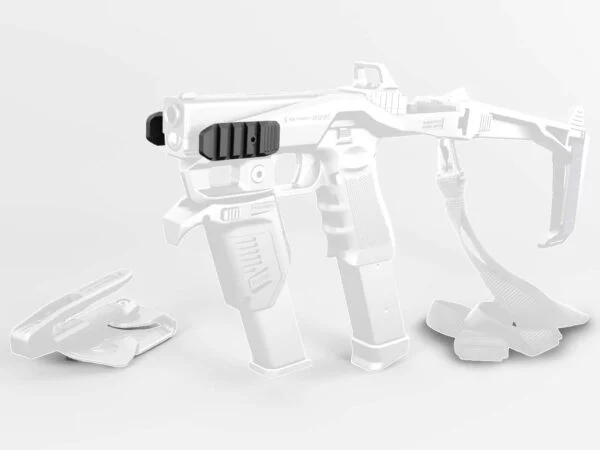
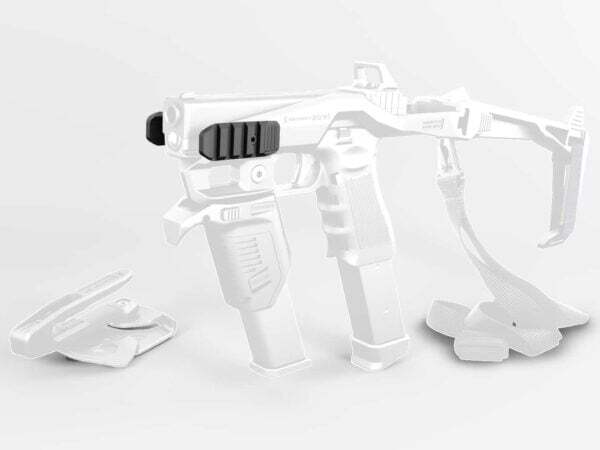
On an AR pistol, the brace slides over the buffer tube. On a Recover Tactical kit, the brace is part of a chassis your pistol locks into. The 20/20N brace folds flat, and your Glock stays fully functional with the brace folded, so the whole setup rides in a G7 OWB holster.
What Is a Stock?
A stock is the rigid rear section of a long gun that locks into the pocket of your shoulder. It sets your length of pull, gives your cheek a repeatable spot for sight alignment, and sends recoil into your upper body instead of your wrists. Buttplate, cheek riser, adjustable positions on a buffer tube. Every part of it assumes a shoulder.
Federal law defines a rifle around that assumption. Under 26 U.S.C. § 5845, a rifle is a weapon designed, made, and intended to be fired from the shoulder. Under 18 U.S.C. § 921, a handgun is designed to be held and fired with a single hand. Bolt a stock onto a pistol, and you have moved the gun from one definition to the other.
Brace vs Stock, Side by Side
| Feature | Pistol Brace | Stock |
|---|---|---|
| Primary purpose | Steadies a handgun against your forearm for one-arm or two-hand control | Anchors a long gun in your shoulder for a fixed, repeatable firing position |
| Point of contact | Forearm of your shooting arm | Shoulder pocket, with a cheek weld on top |
| Typical design | Strap, cuff, or narrow fin, often folding | Rigid buttplate with a set or adjustable length of pull |
| Federal classification on a pistol-length barrel (as of Sept. 23, 2026) | Pistol | Short-barreled rifle under the NFA |
| Federal paperwork on a pistol-length barrel | None for the braced pistol | ATF Form 1 approval before assembly ($0 tax since Jan. 1, 2026) |
| Way to skip NFA paperwork | Keep the brace configuration | Run a 16-inch barrel with a 26-inch minimum overall length |
| Typical use | Home defense, range work, compact PDW-style builds, shooters with limited strength | Accuracy at distance, carbines, pistol-caliber carbines |
| State law | Varies, and some states restrict braced configurations | Varies, and some states ban SBRs outright |
Why Does the Difference Matter Legally?
Because the rules for stocks have held steady for decades, and the rules for braces have flipped several times.
ATF approved early brace designs, reversed itself on shouldering in 2015, reversed again in 2017, then published Final Rule 2021R-08F on January 31, 2023. That rule would have reclassified most braced pistols as SBRs. A federal court in Texas vacated it on June 13, 2024, in Mock v. Garland, and the Department of Justice dropped its appeal in July 2025. On May 6, 2026, ATF proposed deleting the rule's language from its regulations. Comments closed August 4, 2026. As of this writing, the deletion is still a proposal with no final rule published.
The stock side has barely moved. The NFA's SBR definition is the same statute it has been since 1934. What changed is cost. Since January 1, 2026, the federal tax on making an SBR has been $0, and registration plus ATF approval still apply. An August 5, 2026, ruling in Silencer Shop Foundation v. ATF blocked NFA registration enforcement against specific plaintiffs, their members, and their customers. It does not cover every gun owner (NRA-ILA's Q&A walks through who qualifies).
One caution worth repeating. ATF told a federal court in March 2026 that it can still evaluate individual configurations case by case under the statute. A product sold as a "brace" that is shaped, sized, and used like a stock can draw attention. ATF looks at design, and the label on the box carries little weight.
State law runs on its own track entirely. Our Pistol Brace Rule article breaks down which states restrict braces and SBRs, plus what to know before you cross a state line.
Which One Applies to the Pistol You Already Own?
Start with one question. Are you keeping your factory pistol barrel?
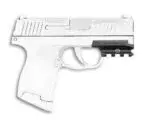
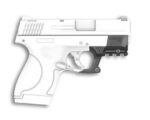
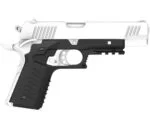
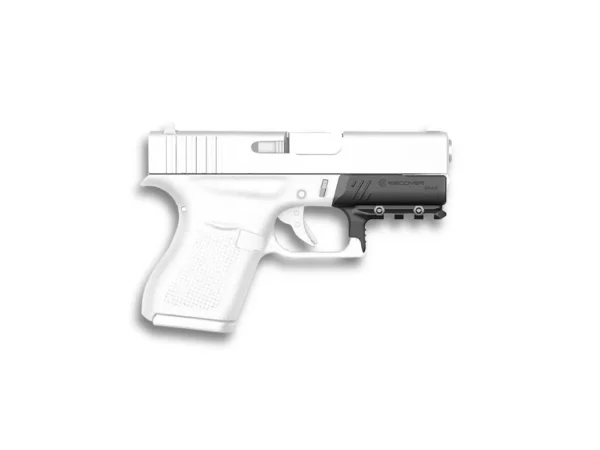
Keeping the factory barrel and want more control? You're in brace territory. The 20/20N fits more than 40 double-stack Glock models, the 20/20N43 covers the G43, G43X, and G48, and there are versions for the S&W M&P (20/22), the full-size 1911 (20/11), and Polymer80 builds (20/80). Installation takes about two minutes, uses your pistol's own sights, and leaves the gun unmodified.
Want a stock with the short barrel? That is an SBR. File ATF Form 1, wait for approval, then attach the stock. The tax is $0, the paperwork still exists, and your state may ban the configuration regardless.
Running an S-PRO? Pay attention to this one. The S-PRO's spring-loaded stabilizer converts to a buttstock when you remove the brace attachment. On a pistol-length barrel, leave the brace attachment in place unless you hold an approved Form 1.
Here's our honest take. Most Glock owners who want a steadier gun for the range or the nightstand get everything they need from a brace-configured kit, with the least legal friction. Chasing shoulder-fired accuracy at 50 yards?
Brace vs Stock FAQs
Can I shoulder a pistol brace?
ATF's pre-2023 guidance treated occasional shoulder contact as leaving a braced pistol's classification unchanged, and the vacated rule's point system no longer applies.
Is a stock on a Glock legal?
Federally, yes, in two situations. A stock paired with a 16-inch barrel and 26-inch overall length makes a standard rifle. A stock on the factory barrel requires an approved Form 1 first. State law can override both.
Did the $0 tax stamp make SBRs unregulated?
No. The tax dropped to zero, and registration, fingerprints, and ATF approval remain in place for most owners.
See stabilizer kits for your pistol → Find Your Kit by model.
Current as of September 23rd, 2026. This is not legal advice. ATF and NFA laws change quickly, and it's up to each owner to know the rules where they live. Recover Tactical is not responsible for misuse of our products.